Melt-o-meter
Architectural Overview
Overview
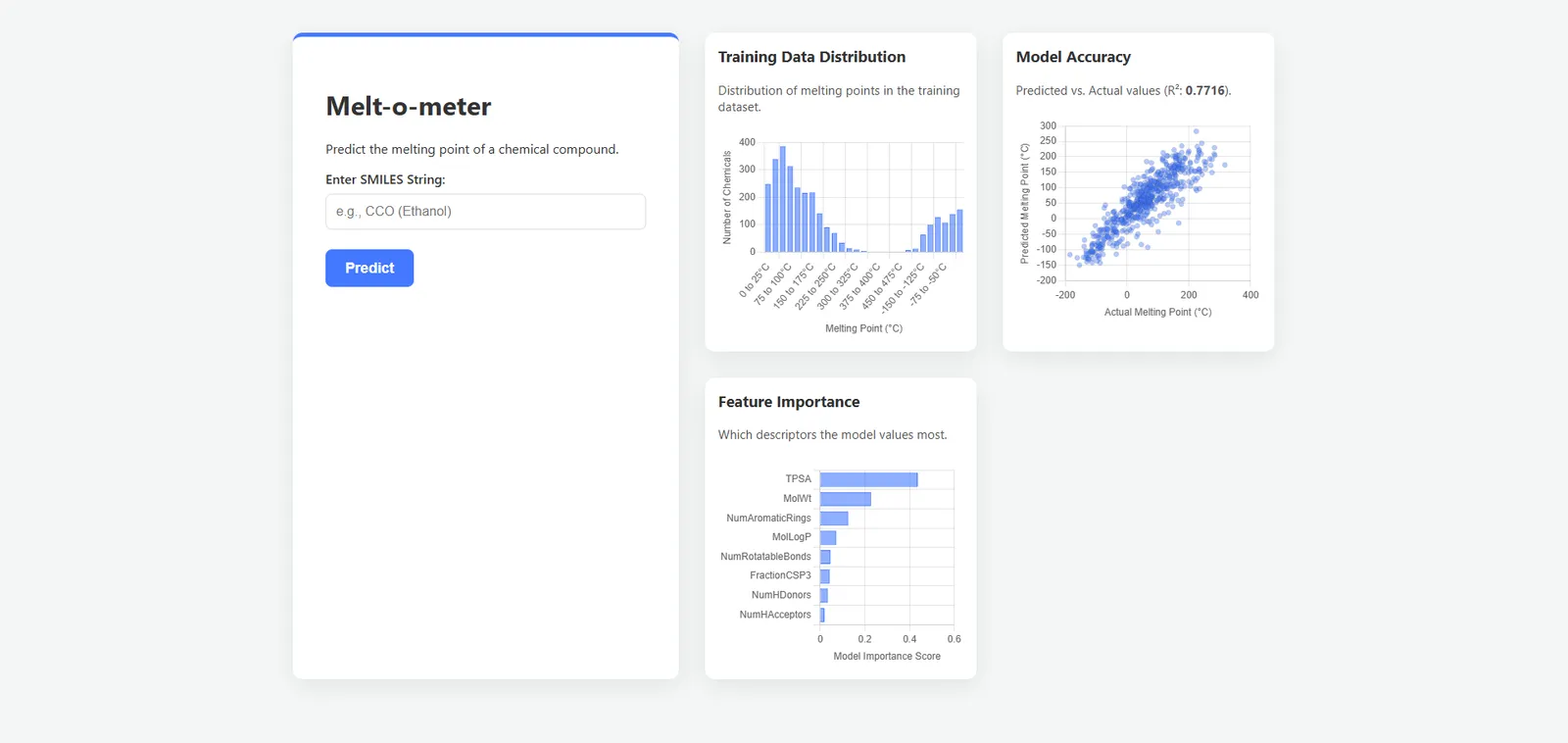
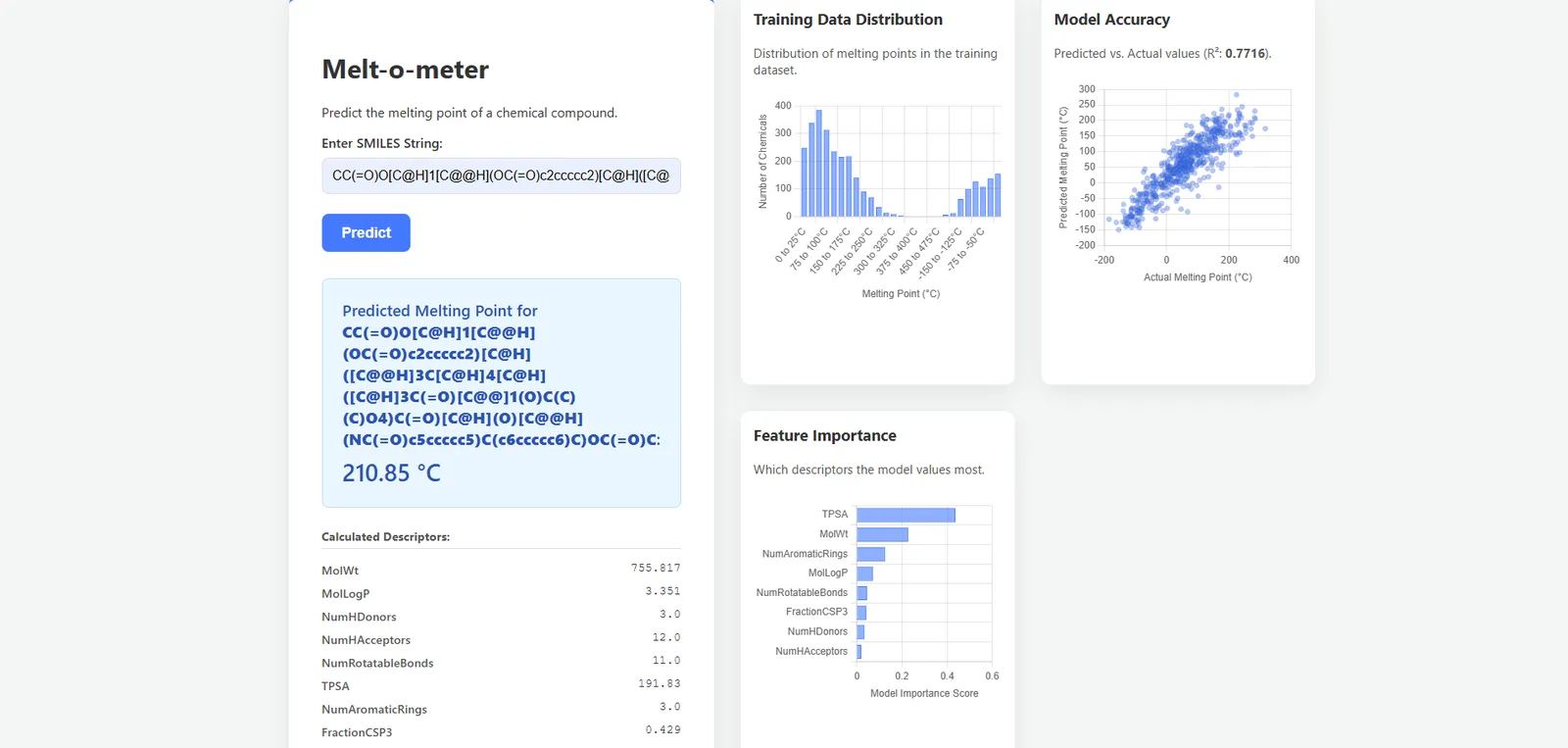
The Melt-O-Meter is a full-stack research tool designed to predict chemical melting points using machine learning. It serves as a prime example of the Vanilla Stack philosophy: delivering high-performance scientific computing through a clean, maintainable web interface without the overhead of heavy frontend frameworks.
It is free and open source available on our GitHub.
The Challenge
Predicting the physical properties of chemical compounds is a foundational task in drug discovery and material science. Traditionally, this requires intensive laboratory experimentation or cumbersome, resource-heavy simulation software. The goal was to build a lightweight, high-availability dashboard that provides instant predictions via an end-to-end data pipeline.
The Solution
By bridging data science with modern web development, I built a system that handles complex inference while remaining lightning-fast for the end user.
Machine Learning Pipeline
- Model: A
RandomForestRegressortrained on chemical feature sets using Scikit-learn. - Data Processing: A custom pipeline built with Python and Pandas to ensure data integrity and feature scaling.
Core Stack
- Backend: Django manages the core business logic, user queries, and model orchestration.
- Dynamic UI: HTMX is used to provide a seamless, SPA-like experience for real-time predictions without the technical debt of a JavaScript-heavy framework.
- Database: PostgreSQL handles persistent data logging and query history.
Engineering & Deployment
To ensure professional-grade reliability and ease of deployment, the entire application is containerized with Docker. The production environment utilizes Nginx as a reverse proxy, ensuring the tool is scalable and secure for real-world research workflows.
Key Technical Insights
- Simplified Frontend: Choosing HTMX over React reduced the frontend bundle size significantly, ensuring the tool remains responsive in low-bandwidth laboratory environments.
- Reproducibility: Using Docker ensures that the specific versions of the ML libraries remain consistent across all environments, which is critical for scientific accuracy.